
Local Reverse Osmosis Installation in Malibu, CA
Tired of hauling water jugs? A 5-stage RO filter goes under your sink, ties into the cold line and drain, and gets its own faucet.
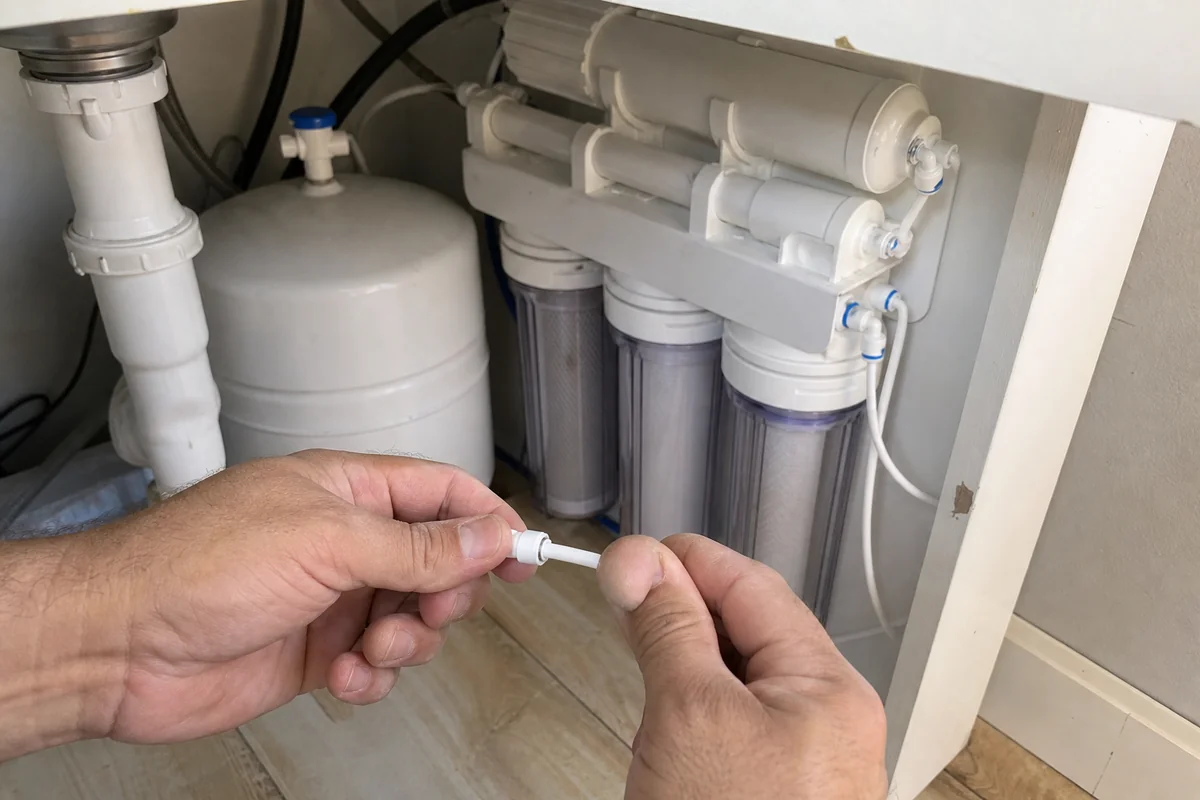
Hauling cases of bottled water up the driveway gets old fast. That's usually when people start looking into reverse osmosis installation in Malibu. Our crew mounts a 5-stage under-sink system, taps it into the cold water line and the drain, sets the small drinking-water faucet on your sink or counter, then fills and flushes the tank before packing up. You buy the unit, or we pick one up for you.
Here's what's not part of the job: selling water tests or telling you what's in your tap. An RO system is a filter, and what it reduces depends on the model and what it's certified for (more on that below). The plumbing under the sink is our part, done neat and dry.
And when the cabinet has room for the tank and there's a spare hole for the faucet, it's a pretty tidy job. One cold supply, one drain, one faucet. Done in an afternoon.
When Reverse Osmosis Installation in Malibu Makes Sense
Buying bottled water every week
Jugs pile up in the garage and the recycling bin. An RO faucet puts filtered water right where you already fill the kettle.
Tap water tastes like a pool
The district uses chloramines as a disinfectant, and some people taste it. The carbon stages in an RO system are there for chlorine, taste and odor.
White crust on kettles and glasses
That's mineral hardness, and Malibu's supply runs hard (numbers below). An RO unit cuts dissolved solids at the one tap you drink and cook from.
Old RO unit leaking or slow
A tank that won't fill, a faucet that trickles or a weeping fitting. Sometimes it's overdue filters. On a tired system with brittle tubing, a fresh unit beats chasing parts.
New fridge wants filtered water
An ice-maker kit tees off the RO line so the fridge and ice get the same water. A short tubing run through the cabinets is our kind of job.
The kit is still in the box
Happens all the time. The box holds a drain saddle, a feed valve, colored tubing and a faucet, and the manual assumes you know where each one goes.
Reverse Osmosis Installation in Malibu for Homes and Rentals
Homes
In a house, the RO usually goes under the kitchen sink, sometimes at a wet bar or prep sink. Before you pick a spot, Zacharias checks where the tank fits, whether there's a spare faucet hole and how the drain runs. That decides the layout more than anything on the box.
Rentals & small business
Office break rooms, small shops and rental units get the same under-sink setup. For property managers, one model in every unit means one filter part number and quicker changes later. Commercial-size RO and anything plumbed into a building's main line goes to a licensed plumber partner.
Our Approach to Reverse Osmosis System Installation
Shut off and look
Close the cold angle stop, open the faucet to bleed pressure and check the valves and drain. A seized old shut-off gets flagged before anything is cut.
Tee off the cold line
An angle stop tee goes on the cold supply with its own small shut-off for the RO. Self-piercing saddle valves are a slow leak waiting to happen, so we leave them out.
Set drain and faucet
The drain saddle clamps onto the tailpiece above the P-trap. The RO faucet goes in a spare sink hole or a new countertop hole, with an air gap faucet if your system uses one.
Fill, flush and check
Hang the filter housings, set the tank, open the valves and let it fill. The first tanks get dumped per the maker's directions while we wipe every fitting with a dry paper towel to catch drips.
The Tricky Installs: Stone Counters, Tight Cabinets and Old Valves
Drilling a faucet hole through quartz or granite is slow work, and we do it with a diamond core bit and water to keep it cool. Done right, it's clean. Rushed, it chips the edge or cracks the slab. No spare hole and no wish to drill? The sprayer or soap dispenser hole can often take the RO faucet instead.
Space is the next fight. APEC lists the 4-gallon tank on its ROES-50 at 11 by 11 by 15 inches, and a cabinet with a disposal, a dishwasher hose and a trash pull-out fills up fast. Sometimes the tank ends up in the next cabinet over with a longer tube run.
Then there's the old shut-off. Original multi-turn valves often won't close all the way, or start leaking at the stem once you touch them. Swapping a compression angle stop is small work. But a soldered valve, corroded pipe in the wall or low pressure that needs a booster pump (which needs an outlet under the sink) is a job for a licensed partner. That same ROES-50 lists 40 to 85 psi feed pressure.
5-stage under-sink RO filter mounted, tapped into the cold line and drain, with its own faucet. Send a photo and the address, and you'll get a straight answer.
(333) 333‑3333What's Different About RO Systems on Malibu Water
Malibu gets its water from Los Angeles County Waterworks District 29, which buys it from the Metropolitan Water District through West Basin. The district's 2025 water quality report says the water met or beat every health-based drinking water standard that year. It also lists total hardness averaging 234 ppm for water from MWD's Weymouth plant and 140 ppm from the Jensen plant, with total dissolved solids averaging 536 ppm and 297 ppm.
So the water's safe by the numbers, and it's hard. Those minerals are a big part of what people taste, and they're tough on an RO membrane over time. So with any reverse osmosis installation in Malibu, we write out the filter schedule for you and suggest you don't stretch it. The median Malibu home was built in 1976, too. The shut-off under your sink may be as old as the cabinet, which is why we check it first.
Can You Install an RO System Yourself?
Plenty of people do. Under-sink kits come with color-coded tubing and push-in fittings, and APEC sells its 5-stage ROES-50 as a do-it-yourself install. Anyone comfortable lying under a sink with a flashlight can usually get one running.
Where DIY installs go wrong: the drain saddle gets mounted below the P-trap, so the line gurgles and can pull sewer smell. Tubing gets cut at an angle and weeps at the fitting. Or the kit's piercing feed valve gets clamped on old copper and drips months later. Take your time on those three spots, then check under the sink again the next morning.
RO Jobs We Handle and When We Bring In a Partner
Our part is installing the under-sink RO unit you bought (or one we pick up), teeing off the cold line, setting the drain saddle and faucet, adding an ice-maker line and swapping out old systems. Under California B&P Code §7048, work done without a contractor's license has to total less than $1,000, labor and materials together, and can't include anything that needs a building permit.
So some reverse osmosis installation in Malibu isn't ours to take. A booster pump that needs a new outlet or circuit, a whole-house RO system, new supply lines through the walls, or any job that would run over the limit goes to a trusted licensed plumber partner. HomeGuide puts whole-house RO at $4,800 to $8,000, well past that line anyway. Zacharias stays your first call and sets up the referral.
What to Expect
- How long does it take?
- A standard reverse osmosis installation in Malibu usually runs two to three hours. Add time for drilling a stone counter, replacing a stuck shut-off, or running a line over to the fridge.
- Will there be a mess?
- Not much. First we empty the cabinet, puts down a towel and bucket, and vacuums up any stone dust from a faucet hole. The first tanks of water go down the drain, which is normal.
- What does it cost?
- HomeGuide puts an under-sink RO system at $300 to $950 installed, with labor alone at $150 to $350. The system you choose, a stone countertop hole, a new shut-off or a fridge line are what move the number.
- Do I need a permit?
- A standard under-sink unit on the existing cold line, drain and faucet hole generally doesn't. A new outlet for a booster pump, a whole-house system or new supply lines in the walls are different, and those go to a licensed partner.
- Do I need to be home?
- Someone needs to let us in and point to where the faucet should go. After that you don't need to hover. Before leaving, Zacharias shows you the RO shut-off and which filter is which.
Reverse Osmosis System Installation FAQ
How much does reverse osmosis installation in Malibu cost?
Cost guides put an under-sink system at $300 to $950 installed, per HomeGuide. That's the unit plus labor, and the labor part alone runs $150 to $350 in the same guide. A pricier system, a hole drilled through quartz or granite, a new shut-off valve or a fridge line all add to it.
What are the five stages in a 5-stage RO system?
On a typical unit like APEC's ROES-50, stage 1 is a sediment filter for dust, particles and rust. Stages 2 and 3 are carbon block filters for chlorine, taste and odor. Stage 4 is the reverse osmosis membrane. Stage 5 is a coconut-shell carbon filter that polishes water coming out of the tank. Other brands shuffle the details, but that's the usual lineup.
How often do RO filters need changing?
Plan on new filter cartridges every 6 months to a year and a new membrane every 2 to 5 years, according to HomeGuide. Your system's manual wins over any general rule. Hard water and heavy use push you toward the short end. Write the date on each housing with a marker when you change it.
Does a reverse osmosis system waste water?
Yes, some. HomeGuide says most systems send 4 to 5 gallons down the drain for every gallon of filtered water. That reject water carries off what the membrane held back. NSF/ANSI 58 includes an efficiency rating and a recovery rating, so compare those numbers between models before you buy.
How do I know what my RO system actually removes?
Check its certification to NSF/ANSI 58, the standard for point-of-use reverse osmosis units. TDS reduction is the required claim. Claims like lead or arsenic reduction are optional and tested model by model. So read the certified claims for your exact model, not the box art. Water testing and health claims aren't something our crew offers.
Need reverse osmosis installation in Malibu?
Text Zacharias a photo of the space under your sink. He'll tell you where the tank and faucet can go.