
Local TV Mounting in Malibu, CA
Big TV, bare wall, cords hanging down? It goes up solid into framing, and the wires get cleaned up.
You bought the TV, the mount is still in its box and you're not sure what's behind the drywall. That's where most TV mounting in Malibu starts. We find the studs, pick the right mount for the room and hang it so it's solid, level and at a height that won't wreck your neck.
A 65-inch screen on an articulating arm pulls hard on a wall. Plastic anchors don't cut it. Wood studs get lag bolts, brick, stone and metal framing each get their own hardware, and the mount gets tested before the TV ever goes up.
Then we deal with the cords. Honestly, that's the part most people care about.
When You Need TV Mounting in Malibu
TV on a stand eating the room
A stand takes floor space and puts the screen too low. Mounting frees up the room.
Can't find the studs
Plaster, lath or heavy texture fools cheap stud finders. So the framing gets confirmed before any drilling.
Over-the-fireplace install
Masonry needs the right anchors, and heat and height both matter. Worth talking through before anyone drills.
Cords dangling down the wall
We hide them behind the wall with a rated power kit or in a paintable raceway on the surface.
Old mount that sags
Loose lags, a mount rated for a smaller TV or bad anchors. It comes down and goes back up properly.
Patio or outdoor TV
Covered patios work, but the hardware has to stand up to salt air. Stainless or coated fasteners only.
TV Mounting for Homes and Small Offices
Homes
Living rooms, bedrooms, family rooms and covered patios. One screen or several in a visit, plus soundbars and a small shelf for the streaming box.
Rentals & small business
Small offices want a screen in the conference room, and short-term rental owners want one in every bedroom. We take those at small scale, mounting and hiding cords, but we don't run network cable through a building.
Our Approach to TV Mounting
Pick height and spot
We sit where you'll watch and figure the center height from there, usually lower than people expect. Window glare gets checked too.
Find and confirm studs
A stud finder first, then a magnet on the drywall screws or a tiny test hole. We don't guess. On masonry we check the brick or stone first.
Mount and load-test
Lag bolts into wood, sleeve anchors into masonry and toggles rated for metal studs. Then a hard pull on the bracket before the TV goes on.
Hang, level, hide cords
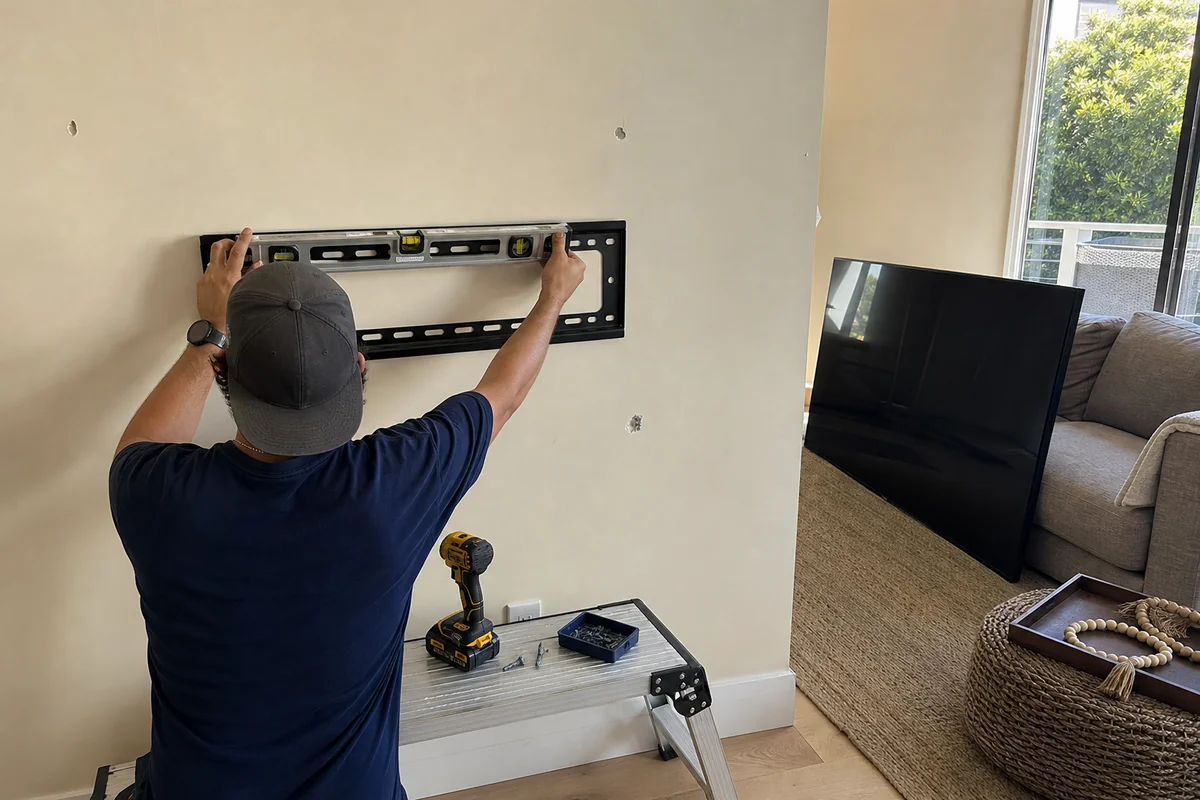
TV on, bubble level, then cables through an in-wall power kit or a raceway painted to match. You get a quick lesson on how the arm adjusts.
The Tricky Walls: Fireplaces, Plaster and Hidden Power
Over the fireplace is the spot everyone asks about, and the one we push back on. Heat rising off the firebox can cook electronics, and the screen usually ends up too high. Quick test: light a fire, wait half an hour and lay your hand flat where the TV would go. Too hot to leave it there? Too hot for the TV.
If you're set on the fireplace, a pull-down mount fixes the height problem. On brick or stone we drill into the solid masonry, not the mortar joints, with sleeve anchors sized for the load. Plaster over wood lath is its own headache. It cracks if you drill it wrong, so we go slow with a masonry bit through the plaster and switch bits for the wood.
Hidden power is the other big one. An in-wall kit uses a recessed inlet behind the TV and a box down low that plugs into an existing outlet. If you want a brand-new outlet or circuit, that's electrician work, and we'll say so.
Flat screens mounted into studs or masonry, level, at the right height, with the cords hidden. Send a photo and the address, and you'll get a straight answer.
(333) 333‑3333What's Different About TV Mounting in Malibu
This is earthquake country. The City of Malibu lists Seismic Design Category D or greater for building here, which is a polite way of saying the ground moves hard sometimes. A big TV hanging off one stud on a long arm is the kind of thing that ends up face down. Spreading the load across two studs helps wherever the wall allows it, and so does folding arms flat when you're not using them.
Housing age matters too. The median Malibu home was built in 1976, so plaster, odd stud spacing and walls added on later are common. Newer rebuilds bring their own surprises, like steel studs and blocking in strange places. So we check before we drill. Every wall.
Can You Mount a TV Yourself?
If it's a fixed or tilting mount, a TV under 55 inches and plain drywall over wood studs, yes. Two people, a stud finder, a drill, a level and the lag bolts that came with the mount. Hit the center of two studs and drill pilot holes.
Where it goes sideways: articulating arms on big screens, fireplace brick, plaster walls and anyone tempted to run an extension cord inside the wall. That last one is a fire hazard, not a shortcut. Power behind the wall needs an in-wall rated kit or a proper outlet.
What We Mount and When We Call In a Partner
Mounting work fits easily under California's minor work exemption, which covers jobs with a total price under $1,000 for labor, materials and everything else, as long as no building permit is needed and the job isn't part of a larger project.
Full home theater builds, new circuits, recessed wall niches or wiring a whole house for audio are a different kind of job. Those go to trusted licensed partners, and we stay in the loop as your first call.
What to Expect
- How long does it take?
- Most single TVs take an hour or two. Fireplace masonry, in-wall cord kits or plaster walls add time. Several TVs in one visit can run half a day.
- Will there be a mess?
- A little drywall or brick dust at the wall. A vacuum goes under the bit as we drill, and the boxes and foam leave with us if you want them gone.
- What does it cost?
- Cost guides put TV mounting at $150 to $400 for labor alone, or $165 to $900 with the mount. Screen size, wall type, mount style and hiding cords inside the wall move the price most.
- Do I need a permit?
- Not for mounting a TV or adding an in-wall power kit that plugs into an existing outlet. A new outlet or circuit is electrical work that can need one, and that goes to a licensed electrician.
- Do I need to be home?
- Yes, at least at the start. You'll want to sign off on the height and position before we drill. After that you can work in the next room.
TV Mounting FAQ
Can you do TV mounting in Malibu homes with plaster walls?
Yes. Plaster over lath is common in older homes and holds a mount fine if you work carefully. The trick is finding the studs behind the lath, drilling the plaster with a masonry bit so it doesn't crack, then lagging into the wood. Plaster also hides studs from cheap finders, so we confirm with a small test hole before the bracket goes up.
How high should my TV be?
In most living rooms, the middle of the screen should sit near eye level when you're seated, often around 42 inches off the floor. Bedrooms can go a bit higher since you're propped up. Above a fireplace is almost always too high without a pull-down mount. Painter's tape on the wall in the screen's size lets you see it first.
Fixed, tilting or full-motion mount?
Fixed if you watch from straight in front, tilting if it has to sit higher, and full-motion if you watch from different spots or need it to swing toward a kitchen. Full-motion arms put the most load on the wall, so they need two solid studs. More motion isn't always better.
Can you hide all the wires?
Mostly, yes. An in-wall power kit runs the TV power and HDMI cables behind the drywall to a spot near an existing outlet. Fire blocking in the wall, or brick? Then a paintable raceway on the surface is the cleaner answer. A regular power cord inside the wall is a fire risk, so that's a hard no from us.
Do you supply the mount?
Either way. Yours works, or we can pick one up. Buying your own? Check that it fits your TV's VESA hole pattern and weight, and get one rated well over what the TV weighs. Cheap no-name arms tend to sag. And if the one you bought isn't up to the job, we'll tell you before we hang anything on it.
Ready for TV mounting in Malibu?
Text Zacharias a photo of the wall plus the TV size. He'll come look and tell you what that wall can hold.